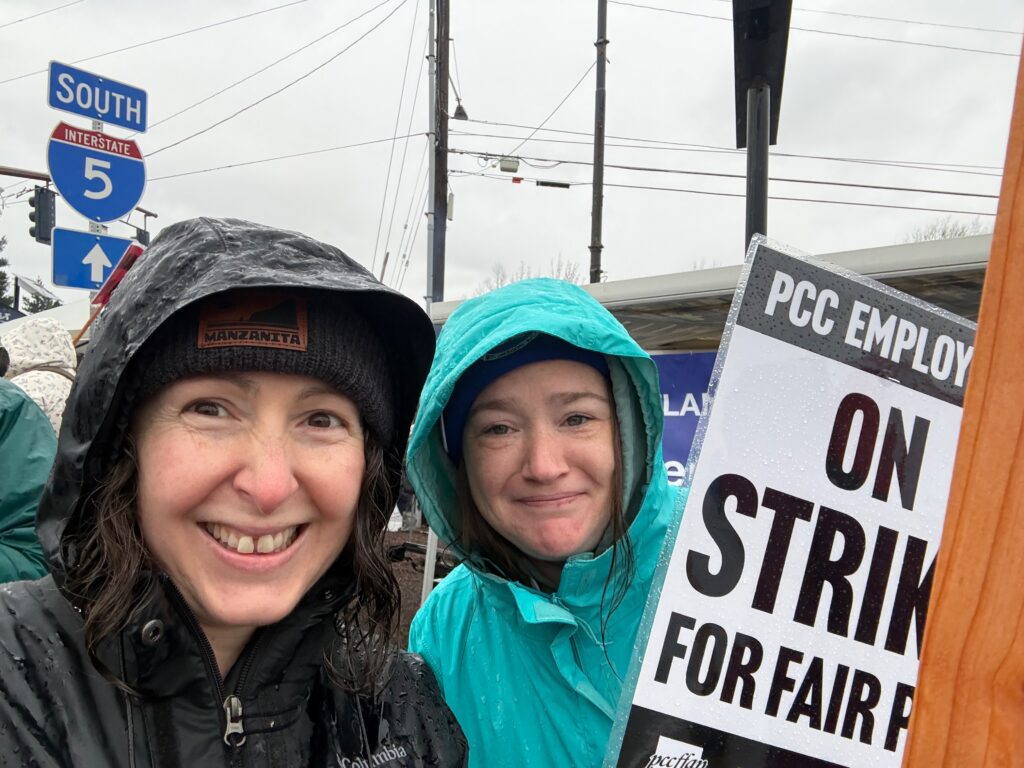
I’m on strike right now, along with thousands of other faculty, academic professionals, and staff at Portland Community College (that’s two unions, friends!). It’s a weird feeling. I never thought I’d be in this position. PCC was the first place I worked where I really felt like the values of the College matched my own. I work with insanely dedicated and caring library workers, faculty, and staff. They believe unwaveringly in what they do and constantly go above and beyond for students. After being here for a few years, I knew this was the place I wanted to work for the rest of my career. Even as administration became worse – more corporatized, more performative, less accessible, more likely to listen to outside consultants than the people who directly work with students – I still never considered leaving because the folks I work with regularly are awesome and I love our students.
As a scholar of time, I’m always interested in different forms of time (queer time, crip time, etc.). Strike time feels really strange. We were talking this morning on the picket line how it feels a lot like early COVID where time moved very differently. We feel like the days are both way too long and super short with not enough time to get everything done but also too much time just staring at different union social channels. We’re totally energized and totally exhausted (I’m lying on the couch like a ragdoll right now after three hours of holding signs, screaming, and dancing, marching and chanting with hundreds of colleagues). In terms of information, we feel like we’re both drinking from a firehose and like we don’t have any of the information we need. We have no idea what the near-term future will bring. What day of the week it is feels almost arbitrary because none of the usual markers of those days apply (I see all the things I was supposed to have been doing at work each day on my calendar and it feels like another life entirely). We’re both unmoored and deeply connected. I love it (the connection and collective power) and I also really hate it (for our students, for our colleagues who live paycheck to paycheck, for what the administration and the Board are doing to my beloved institution).
So it’s weird to feel both temporarily severed from the College and also more deeply connected than ever. These administrators may run the College and have the authority to make decisions, but they are not the College. The College is the people I’ve seen on the picket lines the past few days in the rain and freezing cold. These people who are truly fighting for the soul of our college. They make the College run, from teaching classes, to assisting students with all kinds of needs, to helping students feel welcome, to keeping the College clean and safe and keeping students fed. All of these things are critical and the College can’t run without us, but I’m not entirely sure the same can be said of our administrators. The College is also our students, many of whom have stood with us on the line, who’ve brought us food, or have supported us through emails to the President and Board and on social media. I feel incredibly grateful for our students who clearly see through the bs administration is putting out there.
It’s been kind of incredible to see how unprepared our administration was for this after 11 months in which they barely moved in negotiations. They’ve known for months that a strike was a distinct possibility and they were the ones who walked away from the bargaining table the night before the strike was meant to happen. The latest email from the President said “I will say, with some pride, that we are not – and we should not – be an organization that is good at navigating this scenario” but, honestly, they should have had guidance for students ready to go. Administrators are supposed to plan for scenarios like this. They had units planning for two different scenarios for cuts from the State (neither of which came to pass). We spent almost a year planning what we would cut if LSTA funds went away in our state for the next year (they didn’t, thank goodness). Most faculty, on the other hand, have been talking to students about a possible strike for the past six weeks at least and the union provided tons of resources to help them come up with a plan for their own classes. Yet the College was left totally scrambling last Wednesday as if they had no idea this could happen. Baffling.
It’s been interesting seeing some managers show up to bring food and/or spend a bit of time with us on the line. It’s not a lot of them, but it means a lot to us when someone does. They’ve told us about the absolute unprepared hot mess that is administration right now and it’s nice to realize that not every middle manager tows the party line at all times. But the vast majority of our managers sent us emails just before the start of the strike asking us to let them know if we were working or not, so most are definitely sticking with administration.
I had a boss many years ago who definitely put her employees first and advocated fiercely for us. She said she saw her role as being akin to a manager of a minor league baseball team. She was here to help develop us for bigger and better things in our careers. She was a major mentor to me in my early years in the profession. Since then, the bosses I’ve had really prioritized the people above them in the org chart ahead of the people below them. They have been classic “company [wo]men.” Helping us develop in our careers or even supporting us when we explicitly asked for it wasn’t part of the job. When I was a middle manager, I took the exact opposite approach and that’s why I’m no longer a middle manager. I always saw the role of a manager as supporting one’s direct reports (essentially, I worked for them) and that wasn’t what the people in charge of the library wanted me to do.
The great library leader Mitch Freedman died recently and it made me think about whether leaders like him can really exist in our much more corporatized libraries these days. If you don’t know about Mitch’s storied biography as a library leader and awesome human, please take a moment to read about him here in an obit from his family. When I was coming up as a librarian, he was the sort of man who was a model for me in successfully operating in our field with total moral courage. He lived his values every day. He fought for people and the things that he believed in. He centered the folks who were oppressed. He believed relationships were core to our work. In many ways, he embodied the “Good” and the “Human(e)” characteristics of slow librarianship (maybe also the “Thoughtful” but I didn’t work with him, so I’m not sure). His amazing daughter, Jenna Freedman, also lives her values courageously, a living tribute to his example.
I hope there are still library managers out there still who have moral courage and fight the good fight, but, more and more, it feels like the people who become library Deans, Directors, and University Librarians are the ones who are willing to comply and conform, not the ones willing to rock the boat. As our institutions become more and more corporatized and neoliberal, we see less and less moral courage. I see a lot of library administrators wanting to look like they’re doing good more than they actually want to do good. I think of the leaders who all started EDI initiatives or published EDI statements right around 2020 and then let them fade away. Most of the people I see doing amazing values-driven work in our field these days are not leading libraries. They’re mostly front-line librarians. I wonder if it’s because like me, folks are not willing to make the moral compromises so many have to make these days to climb the ladder.
In “Anthropology and the rise of the professional-managerial class,” the great (and deeply missed) David Graeber wrote about how
the decisive victory of capitalism in the 1980s and 1990s, ironically, has… led to both a continual inflation of what are often purely make-work managerial and administrative positions—”bullshit jobs”—and an endless bureaucratization of daily life, driven, in large part, by the Internet. This in turn has allowed a change in dominant conceptions of the very meaning of words like “democracy.” The obsession with form over content, with rules and procedures, has led to a conception of democracy itself as a system of rules, a constitutional system, rather than a historical movement toward popular self-rule and self-organization, driven by social movements, or even, increasingly, an expression of popular will.
I see that in my own place of work. So much of my boss’ (our Dean’s) job is box checking compliance type work – approving vacations and sick leave, making sure we’re doing required trainings and other things the people above her on the org chart want us to do, making sure we’re doing all of the things contractually required of us, etc. It used to be that I met with her once each term to talk about what I was working on, go over my progress on my goals, etc. Then I went to meeting with her just once in Fall where we’d look at my goals document (without any meaningful feedback or support) and then I’d fill out a Google form at the end of the year to tell her what I did (with again no meaningful feedback). Now, even that Fall meeting is gone as her load of compliance-related work has increased. There’s no support outside of helping us navigate the bureaucracy of our institution. There’s no “walking around” as Mitch Freedman did – building relationships with employees and making them feel seen. There’s no focus on our development or talking about the meaning behind what we do. There’s just this compliance-focused flurry of activity.
As our colleges and universities become more and more corporatized, they turn what were supposed to be leadership positions, that required vision and people skills, and turn them into babysitting jobs because, lord knows, we professionals can’t be trusted. Our college, like many, has seen a massive growth in the number of managerial positions, and yet, faculty and staff are being asked to do more administrative work than ever before, not less. Why? Well, of course those managers have to justify their existence.
Could a Mitch Freedman become a library director today? Would he have had to compromise his values somewhere down the line to get there? Do you know of any library leaders like Mitch today who are able to operate successfully in these more neoliberal environments?
In that same piece, David Graeber writes “scholars are expected to spend less and less of their time on scholarship, and more and more on various forms of administration—even as their administrative autonomy is itself stripped away. Here too we find a kind of nightmare fusion of the worst elements of state bureaucracy and market logic.” This is the reality we find ourselves in as our two unions fight for better pay, but even more importantly, for a real, substantial model of shared governance which we don’t currently have (and which our college President agreed to and then hired a consultant to create for us 🙄). The fact that the only college committee or governance group that has the ability to conduct a vote of no confidence in our President (which they successfully passed!) is our student government is a stark reminder of how little power and voice we have in the future of our college. It can be so easy to just focus on keeping our head down and doing the good work we do as educators, as supporters of students and faculty, as stewards of collections, etc., but when we fight together like this, we fight for the heart and soul of our organization. We fight for an organization that centers students and their needs and listens deeply to those who directly serve and educate them.
Walking the picket line the first couple of days was brutal in many ways. I was so cold and wet I couldn’t even grip my cell phone or a car door handle and I had to stay off my feet for a few hours as they thawed. But what has kept me warm, has kept all of us warm, is the solidarity. It has sometimes felt almost like a party, being there with many hundreds of my fellow colleagues. It’s been so affirming, so energizing. We’re all so united in this, so deeply committed to the institution and each other in ways that these administrators who jump from job to job every few years and compose soulless emails to us with freaking ChatGPT will never understand.
If you’re feeling so inclined, please contribute to our strike fund. The administration seems really dug in and even decreased their offer by over $100,000 on Sunday, so I’m not quite so optimistic anymore that this will end quickly and we have lots of faculty, academic professionals, and staff who won’t be able to pay their rent or mortgage without support. Thanks and solidarity!! ✊